Aggregate Demand Curve
AD = C + I + G + Xn
Shows the demand by consumers, businesses, government, and foreign countries.
Changes in the price level cause a move along the curve.

Why is the AD downward sloping?
- Real-Balance Effect
- Higher price levels reduce the purchasing power of money.
- This decreases the quantity of expenditures.
- Lower price levels increase purchasing power and expenditures.
- Interest-Rate Effect
- When the price level increases, lenders need to charge higher interest rates to get a REAL return on their loans.
- Higher interest rates discourage consumer spending and business investment.
- Foreign Trade Effect
- When U.S. price level rises, foreign buyers purchase fewer U.S. goods and Americans buy more foreign goods.
- Exports fall and imports rise causing real GDP demanded to fall (Xn decreases).
- GDP = C + Ig + G + Xn
- Two parts to a shift in AD:
- A change in C, Ig, G, and/or Xn.
- A multiplier effect that produces a greater change than the original change in the 4 components.
- Increase in AD = AD >
- Decrease in AD = AD <
- Consumption

- Household spending is affected by:
- Consumer wealth ( ^ wealth, ^ spending)
- Consumer expectations ( ^ expectations, ^ spending)
- Household indebtedness ( if debt decreases, spending ^)
- Taxes (if taxes decrease, spending ^)
- Gross Private Investment
- Investment spending is sensitive to:
- Real Interest Rate (if interest rate decreases, investment ^)\
- Expected returns ( ^ expected returns = ^ Investment)
- Influenced by:
- Expectations of future profitability
- Technology
- Degree of excess capacity
- Business taxes
- Government Spending
- ^ government spending = AD >
- Decrease in government spending = AD <
- Net Exports
- Sensitive to:
- Exchange rates (International value of $)
- Strong $ = more imports/fewer exports (AD < )
- Weak $ = fewer imports/more exports (AD > )
- Relative Income
- Strong foreign economy = ^ exports (AD >)
- Weak foreign economy = less exports ( AD < )
Aggregate Supply

- Long Run
- Input prices are completely flexible and adjust to changes in the price-level.
- Real GDP is independent of price-level.
- Short Run
- Input prices are sticky and don't adjust to a change in price-level.
- Level of Real GDP is directly related to price level.
- Long Run Aggregate Supply (LRAS)
- Marks the level of full employment in the economy.
- Because input prices are completely flexible in the long-run, changes in price-level do not change firms' real profits.
- LRAS = Vertical
- Changes in SRAS
- Increase in SRAS = >
- Decrease in SRAS = <
- Per-Unit cost of production = total input cost / total output
Determinants of SRAS
- Input prices, productivity, and legal institutional environment affect unit cost per production.
- Input prices
- Domestic Resource prices
- Wages (75% of all business costs)
- Cost of capital
- Raw Materials (Commodity prices)
- Foreign Resource prices
- Market power
- Increase in Resource prices = SRAS <
- Decrease in Resource prices = SRAS >
- Productivity = Total output / total input
- More productivity = lower unit of production = SRAS >
- Less productivity = higher unit of prodution = SRAS <
- Legal Institutional Environment
- Taxes and subsidies
- Government regulation
- Cost of compliance = SRAS <
- Re-regulation = SRAS >
Full Employment

- FE Equilibrium exists where AD intersects SRAS and LRAS at the same time.
- Recessionary Gap: When equilibrium point occurs below full employment output.
- Inflationary Gap: When equilibrium point occurs beyond full employment output.
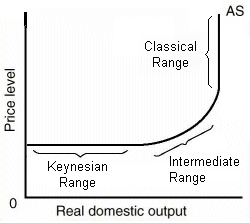
- Classical(Vertical) Range: Inflationary
- Keynesian(Horizontal) Range: Recession

No comments:
Post a Comment