- Nominal Wages: Amount of money received by a worker per unit of time.
- Real Wages: Amount of goods/services a worker can purchase with their nominal wage.
- Sticky Wages: Nominal wage level that is set according to an initial price level and does not vary due to labor contracts or other restrictions.
- Recession(Keynesian Range): Fixed price and wages and flexible employment level.
- Output depends upon changes in employment level.
- Intermediate Range; Flexible price and employment level and fixed wages.
- Output depends upon changes in price and employment level.
- Inflationary Range: Flexible price and wages and fixed employment level.
- Output is independent of changes in the price level.

Investment
- Money spent or expenditures on new plants (factories), capital equipment (machinery), technology (hardware and software), new homes, and inventories (goods sold by producers).

- How does business make investment decisions?
- Cost/Benefit Analysis
- How does business determine benefits?
- Expected rate of return
- How does business count the cost?
- Interest costs
- How does business determine the amount of investment they undertake?
- If expected return > interest cost, then invest.
- If expected return < interest cost, do not invest.
Real (r%) vs. Nominal (i%)
- Nominal is the observable rate of interest.
- Real subtracts out inflation (pi%) and is only know ex post facto.
- How do you compare the real interest rate (r%)/
- r% = i% - pi%
- What then, determines the cost of investment decision?
- Real interest rate (r%)
Investment Demand Curve (ID)
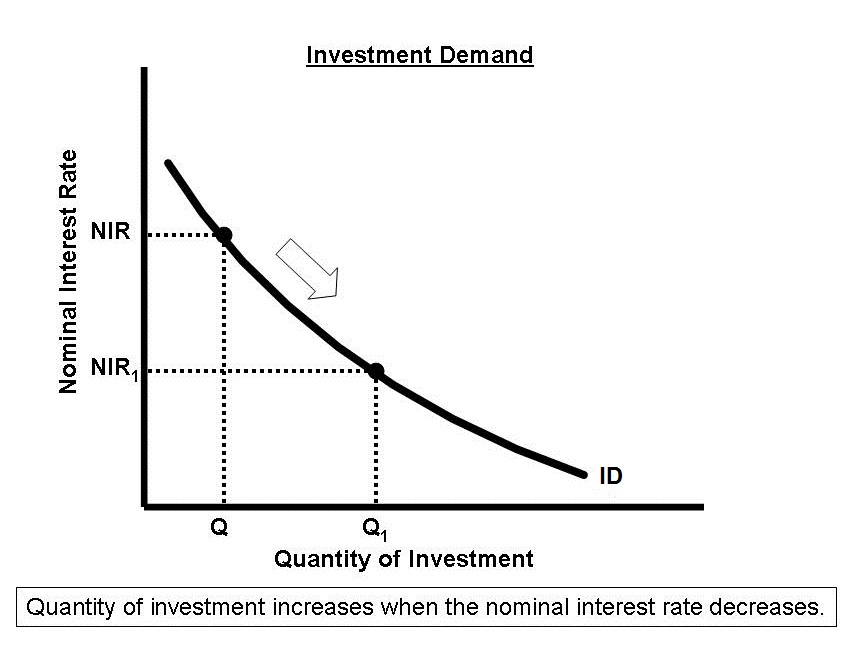
- What is the shape of the Investment Demand Curve?
- Downward sloping
- Why?
- When interest rates are high, fewer investments are profitable.
- When interest rates are low, more investments are profitable.
- Cost of production
- Lower costs shift ID >
- Higher costs shift ID <
- Business taxes
- Lower business taxes shift ID >
- Higher business taxes shift ID <
- Technological Change
- New technology shifts ID >
- Lack of technological change shifts ID <
- Stock of capital
- If an economy is low, then ID >
- If capital increases, then ID <
- Expectations
- Positive = ID >
- Negative = ID <

No comments:
Post a Comment